
Riffing about Reading
How "fundamental" is it?

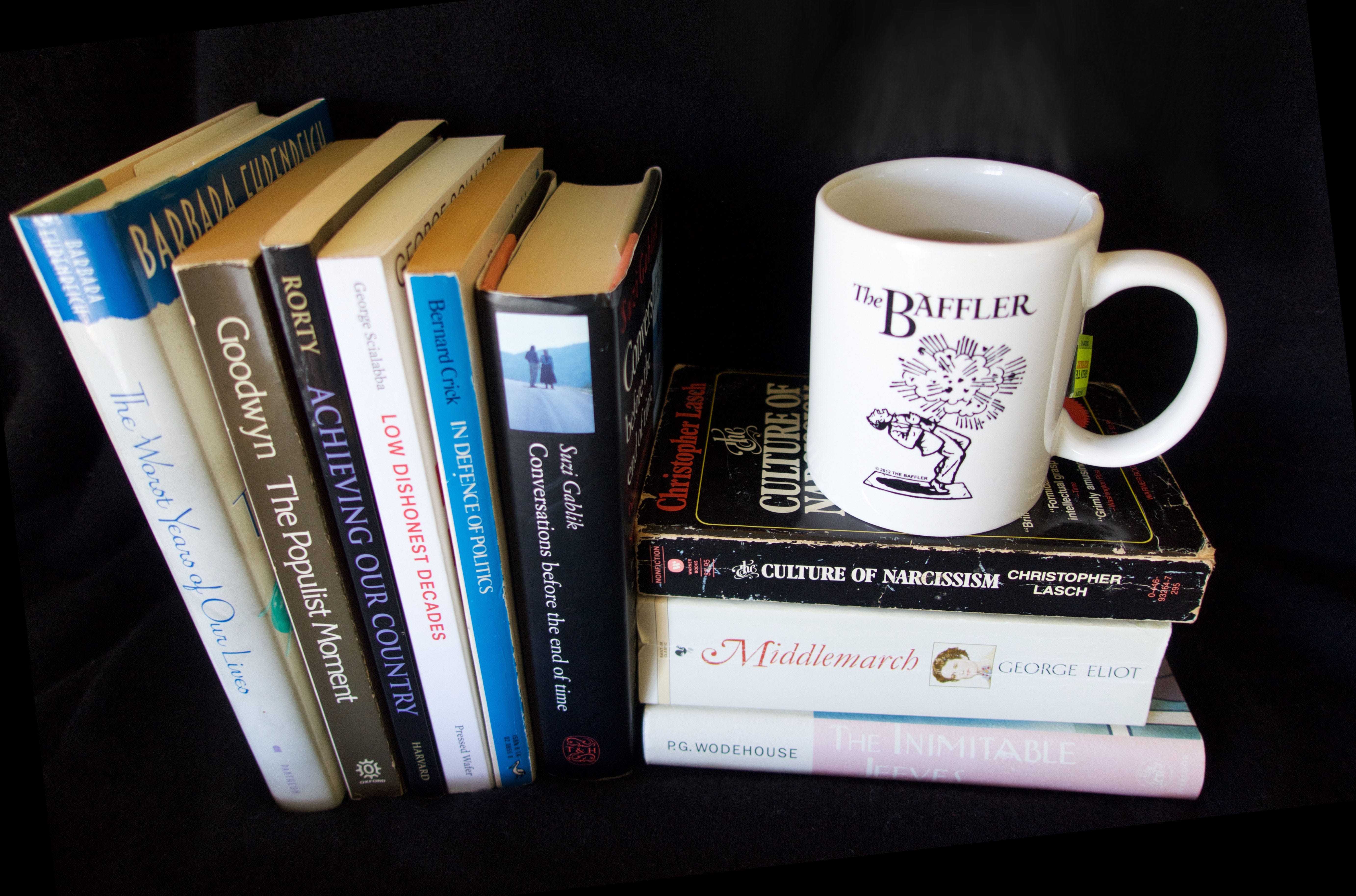
Dear Readers Who Still Read,
Some of you will remember the old public service spots that asserted “reading is fundamental.” There are a bunch of them from the ’70s and ’80s archived on YouTube, such as this somber one from 1973 and this one from 1980 starring Ed Asner and some kids. Kind of charming! The tagline was lodged in my memory but somehow I’d forgotten who was behind it: the non-profit organization called, hmmm, Reading is Fundamental. Nor did I know until just now that RIF was set up in 1966 by Margaret McNamara, the wife of Robert McNamara, the U.S. secretary of defense who led the nation deeper into the Vietnam quagmire in the mid- to late-1960s.
Now about to turn 60, RIF is still active in promoting childhood literacy. And the group still makes ads promoting “the joy of reading.” I see here that their 2016 READ PSA was a finalist for a “Shorty Award.” (Who knew that there was such a thing as the Shorty Award to honor excellence in social media?) If you review the RIF history on its website, you will see that the organization has a track record of success in getting government and foundation funding, as well as financial support from an array of big corporations.
The support for literacy from big business isn’t surprising: most companies prefer to have employees who can read. It’s also ironic, if you think about it. Where is the biggest threat to childhood (and adult) literacy coming from in our modern era? From Big Tech. From the people whose business model is to get young people addicted at an early age to screens and then phones and video games and TikTok, and YouTube. . .
Today’s tech has produced a multi-directional assault on our attention spans. I was enjoying some of those old PSAs on YouTube, but soon I was presented with something more interesting than the social problem of literacy. The algorithm knows me well enough to steer me to a different problem. So, before long I was spending a few minutes with a (very good!) video called “One Common Mistake Most Bowlers Make.” The advice here is to “stop throwing the ball.” You want to roll it, not throw it.
But, I digress . . .

Let’s stay focused: the subject here is literacy. And how to think about the contention that, despite so many years of effort by RIF and the embattled school systems, we are much closer to being a “post-literate” society. This was the idea behind our most recent issue of The Baffler, and I must say: I thought this was one of the best issues of our magazine in a while (not to discount our recent Sports & Competition issue, which featured articles on female bodybuilding, professional bull-riding, and one bowler’s struggles with Changing Lanes).
Our “After Words” issue had some real gems. Noah McCormack has been thinking for a long time about the ways the printed word is losing out in a culture more oriented toward images and talk. He cites the Jesuit scholar Walter Ong, “who, two generations ago, discussed the transition from oral culture to print culture and the transition in the television age into what he called ‘secondary orality.’” As Noah writes here, there are many critics who fear, as one put it, that “a return to orality will fundamentally rewire the logic engine of the human brain.”
This belief that technology “wires” the human brain has many parents, most notably Marshall McLuhan and his follower Elizabeth Eisenstein. . . . Preoccupied with the “fixity” of print, she attributed a dizzying array of changes to its arrival, from the scientific revolution to Protestantism to political liberalism. Ong drew on her, while Neil Postman’s seminal 1985 tome, Amusing Ourselves to Death: Public Discourse in the Age of Show Business, drew on all of them. There are internal disagreements between these authors, but fundamentally they are telling one story: technology changes us, and it is currently changing us for the worse.
For many people today, keeping up with the news—and trying to make sense of it—is a matter of listening to podcasts. Is that a good trend? We’ve got one of the most popular podcasters on the left, Brace Belden, suggesting that from his own experience “it’s difficult for most people (including myself) to express complex thoughts on a podcast.”
Frankly, complexity can work against you; what you want are sound bites, sections produced memorably enough to snap listeners out of their fugue and rewind fifteen seconds to hear it again. Most listeners are half-listening, so repetition, conversational language, humor, and emotion are significantly more important than actually saying anything interesting.
Sophie Pinkham, who has a two-year-old daughter, wrote here about the childhood literacy problem—especially the tension between screen time and book-reading time. From the perspective of an exhausted mother, she writes, it can seem like “YouTube is the perfect parent: its energy never flags.” That’s where she and her daughter discovered Rachel Accurso, better known as Ms. Rachel.
Ms. Rachel has often spoken in interviews about her childhood love for Mister Rogers’ Neighborhood, and about revering Rogers as an adult. Part of the secret of her own success is her promise of a better kind of screen time, in the tradition of Mister Rogers or Sesame Street. Her videos are meant to be something virtuous rather than a mere source of parental relief—since the desire for relief is often seen as a form of parental failure.
But the ways that technology changes all kinds of cultures really hits you in our “Brain Rot Without Borders” section, in which seven writers from around the globe talk about the state of reading in their countries. Consider this, by Zhang Yueran, about the popularity of “web fiction” and entertainment in China, especially among today’s youth, “for whom reading is a thing of the past.”
They grew up scrolling short videos and are used to their cultural products being both literal-minded and fragmentary. Originality is of no concern to them. China is going through a trend of drama series shot vertically, to be watched on a phone, each episode no more than three minutes. . . . The meaning and power of language is in the process of being flushed away.
Well, readers, what is there to do? I would say: put down your phones and get your hands on a copy of the latest print edition of The Baffler. Or, a worthwhile book. (More on that in my next newsletter. Stay tuned.)
When I was in New York last week, I was presented with a print edition of a brand new publication called The New York Review of Finance. It contains no useful financial advice, no boosterism about the ways AI will reshape the economy, and no enthusiasm about the current prices of gold, crypto, or blue-chip stocks. Oddly, it has no masthead and no bylines. Don’t bother to look for it online.
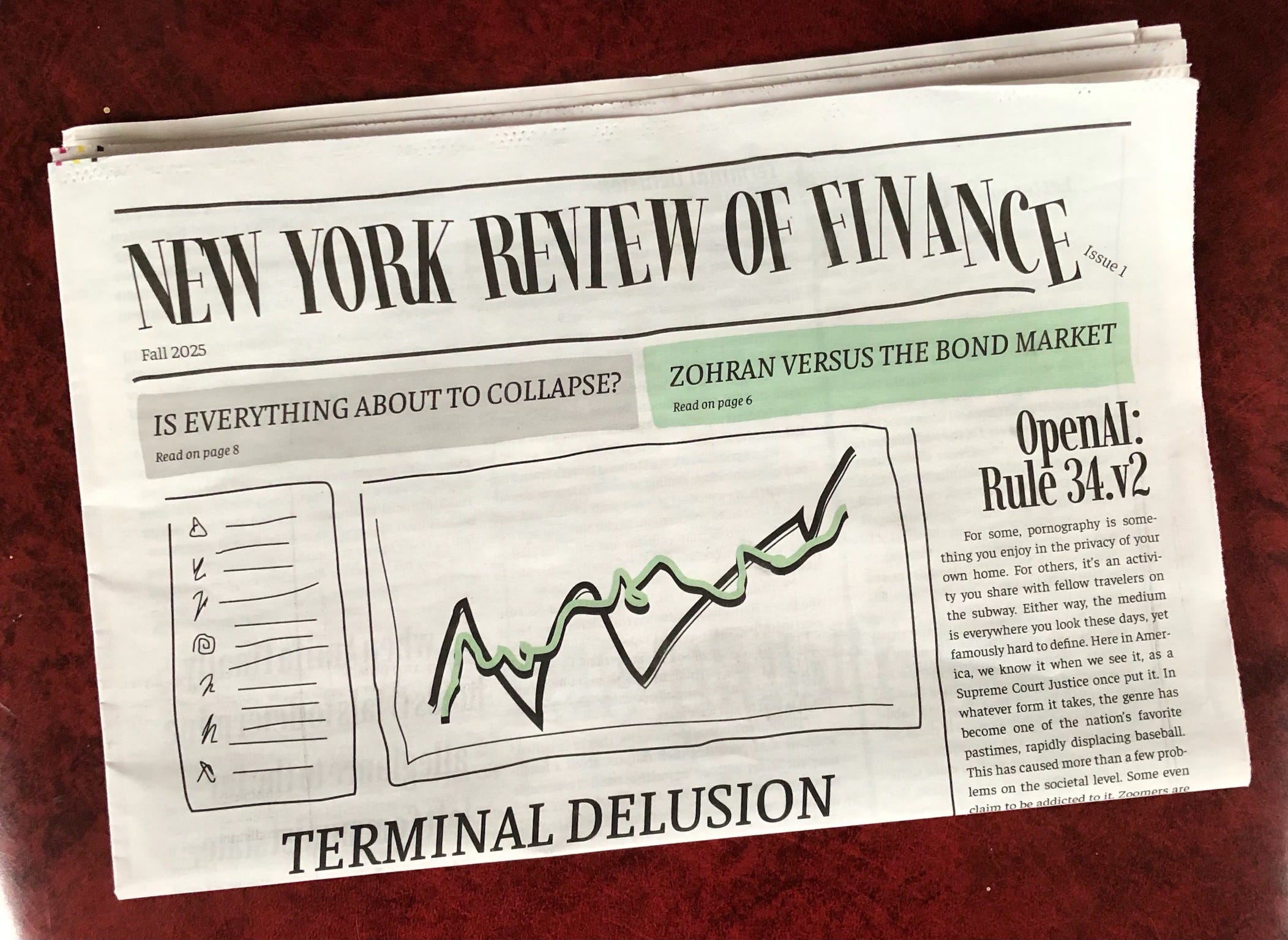
What could be more countercultural at this moment? There’s a bit of buzz lately that maybe it’s time to escape the chase for attention on social media and refuse to play the algorithm game on the big platforms. As Katherine Dee wrote in GQ, “To be countercultural today is to refuse spectacle. It is choosing not to turn your life into fuel for platforms. It is opting out without announcing to your followers that you’re opting out.” Kyle Chayka wrote in The New Yorker that it’s becoming cool to have “a conspicuously modest following” on social media these days.
I send my congratulations to those of you out there with modest follower counts. For those of you at net zero, I often get the feeling I am moving in your direction. To paraphrase economist John Maynard Keynes: in the long run we’re all deactivated accounts.
A note for those who remember the old counterculture. My sister in Wisconsin recently sent me two packages of the new version of the Guerrilla Cookie. This legendary product first appeared on the shelves of the Mifflin St. Co-op in Madison in 1969. They were delivered by the baker Ted Odell, who hadn’t bothered to give the cookie a brand name. Someone at the co-op put a sign up labeling them “Guerrilla Cookies” and Ted went with it. Longtime readers of this newsletter will know the whole tale, which appeared in The Baffler’s food issue in September of 2023.
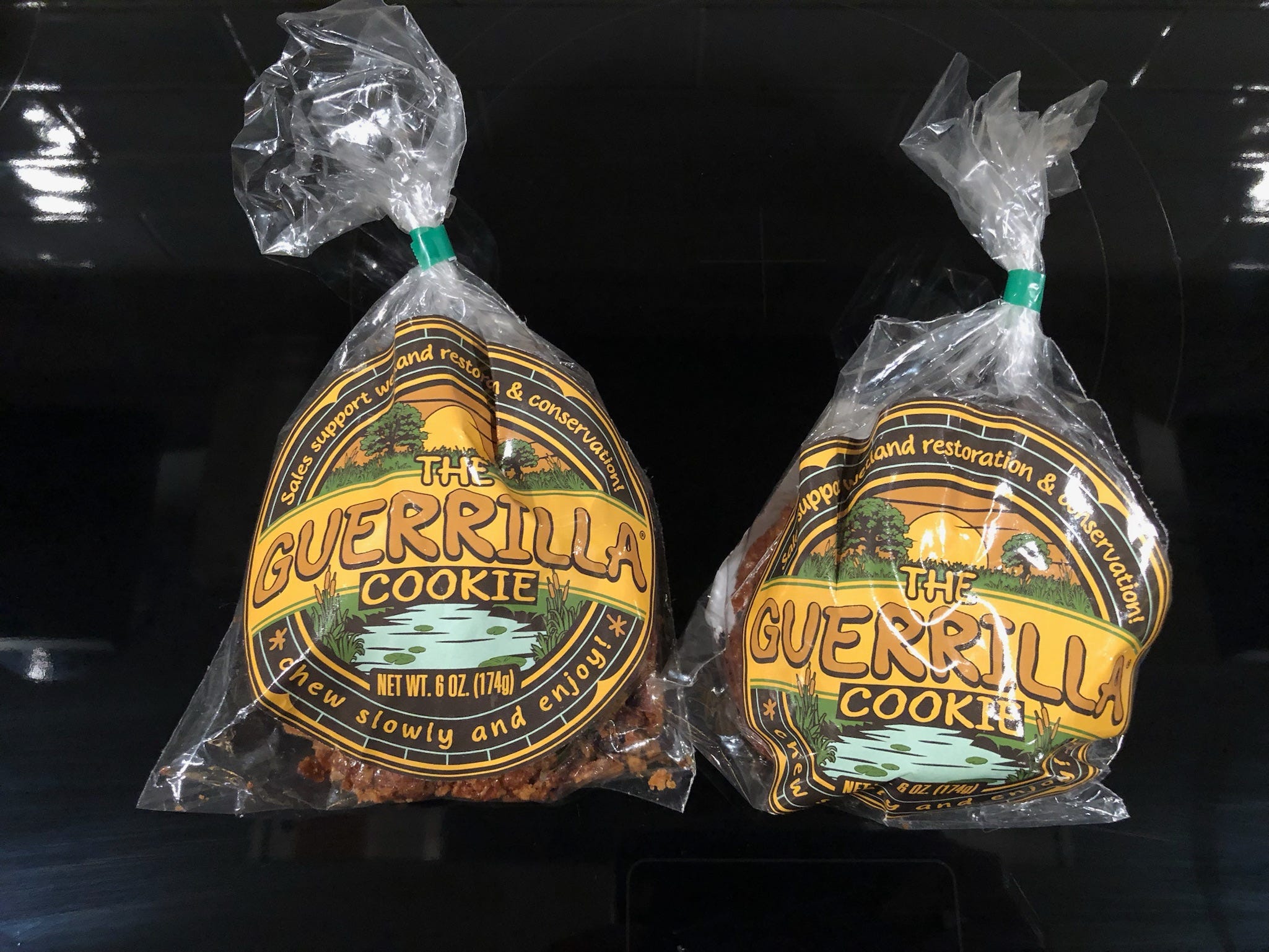
You can bet I took the label’s advice to “chew slowly,” an admonition that appeared on Ted’s original hand-drawn label. I sampled these items meditatively, as if a quiet concentration could tell me whether these tasted exactly the same, or almost the same. I had heard from the new baker, Mike Olson, earlier this year, who admitted he dreaded the inevitable complaints that his re-creation just wasn’t the same. “I have said over the years that even if I nailed the recipe, it would not be accepted by the guerilla cookie alumni,” he wrote.
My verdict: It’s very close! I am happy to accept it.
Thanks for reading! Please do let me know if you wish the Dots & Arrows newsletter would focus a bit more on the best bowling videos you should be watching right now.

Good advice on all subjects. And thanks for including me in that very distinguished company on your bookshelf. -- GS