
A Friend Writes. . .

Dear Readers,
Remember when The New Yorker’s “Talk of the Town” section would regularly feature dispatches introduced by “A friend writes. . .”? For a time I took that literally and thought these were letters sent in by especially literate readers of the magazine. I learned somewhere in my young adulthood that these vignettes were written by staff writers and regular paid correspondents.
When Tina Brown took over as editor of The New Yorker in 1992 (at age 38) that was the end of a friend writes. “I think it’s a kind of an unnecessary constraint, and it’s become arch,” she told the New York Times. She decided the short “Talk” pieces should be signed, which now seems a perfectly reasonable decision.1
In this edition of Dots & Arrows I am not being arch, I’m being literal: Several friends did write in after reading my May 31 letter entitled “Remember the 1990s?” Thank you to those who wished me well on my recent, um, change in status. I do like hearing from readers; it addresses the nagging worry “did the email go through?” Did people read it? IS THIS THING ON?

The Question of Meaning. I mentioned last month the self-consciousness so many of us feel about attending to, or publicly discussing, minor concerns that are not part of the General Emergency. And about being a “scribbler” instead of a participant in direct action. One of my readers translated that into the questions asked by Australian rock band Midnight Oil in their 1987 hit “Beds are Burning”: How can we dance when our earth is turning? How do we sleep while our beds are burning? She suggested the question was answered perfectly well by Victor Frankl: “The last of the human freedoms: to choose one’s attitude in any given set of circumstances, to choose one’s own way.” Writing is one way to exercise the spark of freedom, she (upliftingly) writes.
More about the CITGO sign in Boston:
One friend described “my one and only needlepoint project in the 1990s—a wedding shower gift for my childhood bestie whose wedding theme was Save Fenway Park. I embroidered a hand towel with the CITGO sign for her marital home. (She had her shower tiled to look like the green monster.)”
And a friend who is well versed in energy and engineering notes the changeover from neon lights that were used when the sign went up in 1965 to LED in recent years. He tells me:
“From what I read, the sign uses about $18K a year in electricity, which is not bad considering how central it is to the city’s identity. So the city will save enough ($9K) to buy a high-mileage used car… If that number is accurate, those new LEDs are actually pretty amazingly efficient. This suggests the sign only draws something like 25kW [25,000 watts] of power. To put that in perspective, my house alone probably draws around 4k W when the AC is running.”
I made a snarky remark about Pat Boone in the recent letter. I think of him as a Goldwater supporter and a Reaganite and someone whose “crooning” was not to my taste. He is apparently still alive, at 92.
A sports-aware friend writes:
“As I learned in a fine doc series called Soul Power, Boone was the founder and racially progressive owner of the Oakland ABA franchise, the Oaks. [That was the American Basketball Association, which later merged into the NBA—ed.] At a time when the NBA was reluctant to sign Black players, the ABA did so and featured them prominently. Not as prominently as Rick Barry, but you take my point. So at least props for that.”
I didn’t know that. I do remember the ABA, which used a red-white-and-blue basketball and was the showcase for a young Julius Erving, before he was a star for the Philadelphia 76ers. I see here that Dr. J. was the executive producer of Soul Power.
And speaking of the NBA. . . I have a few friends who are fanatical about the New York Knickerbockers. Well, this seems to be their year. It’s a big advantage when you’ve got not one but two players who become invincible when the pressure is on — Brunson and OG Anunoby.
One of the things that seems different in this era from when I grew up—and which I also think is just plain bonkers—is the way people bring the conspiratorial thinking common in politics into the sporting arena. Thus, when Spurs player De’Aaron Fox made the boneheaded play that cost the Spurs the game on Wednesday, online idiots said things like “he should be investigated by the FBI.” This is one way that gambling has polluted the game; people suspect there are gambling-related reasons to whatever players do. It’s true that Fox got the ball with his team up by one point and only fifteen seconds on the clock. Obviously he should have dribbled out the clock. But he went for a hard-charging layup and got blocked. Anyone who doesn’t understand how an athlete can do exactly the wrong thing in the heat of the moment, making a split-second decision that looks terrible in retrospect, has never experienced athletic competition. Go back to your couch and shut the hell up!
Now, here’s a FANtastic glimpse into the mind of a lifelong Knicks partisan, my old friend Bob. I grew up with a similar strong attachment to the Chicago Bulls, and a disdain for the Knicks and the Celtics. We had our days of glory in the Michael Jordan era. Now it’s time, I guess, for the Knicks, who have not won it all since 1973. Bob details the relevant history here, along with an account of “the Hut’s Incident.” Recommended reading.

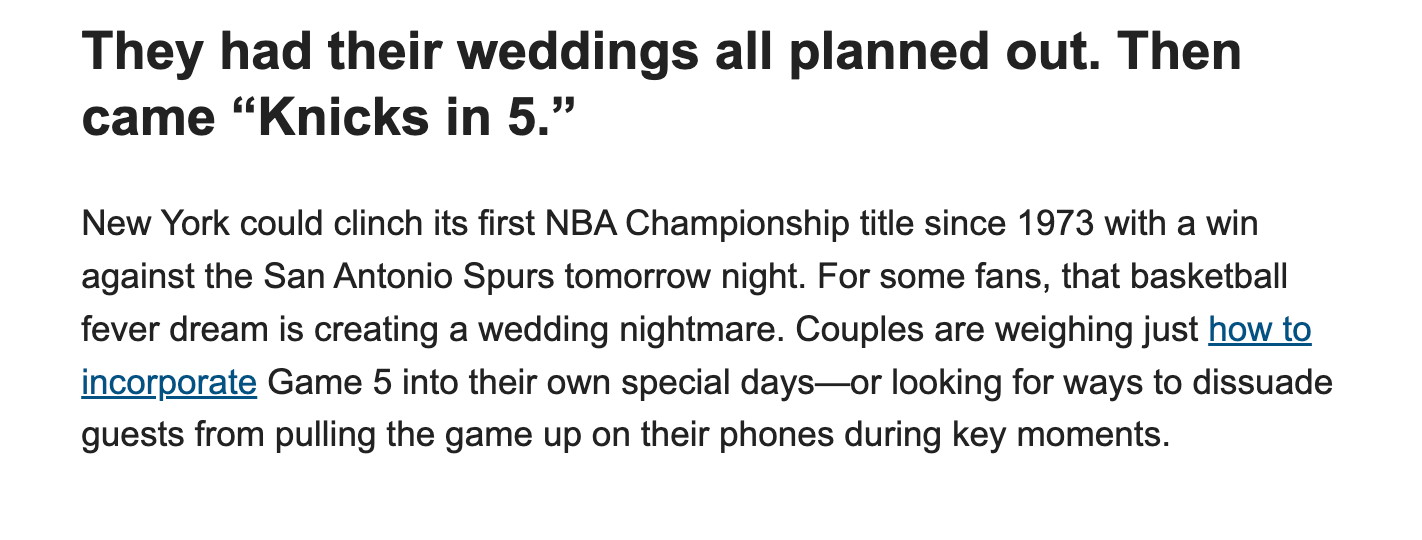
This Saturday evening might not be a good time for your wedding reception. From the Wall Street Journal’s daily newsletter:
She made a lot of changes. The attempts at humor that were long called “casuals” became “Shouts & Murmurs.” Calvin Trillin describes the effort to get casuals in the magazine in “Some Notes on Funniness.” He writes: “Burt Bernstein, for instance, worked for untold hours on a palindromic casual. It was in the form of a play called ‘Look, Ma, I Am Kool!,’ and it had characters delivering lines like ‘Nail a timid god on rood. Door no dog, dim Italian.’ The New Yorker passed.” Bernstein (the younger brother of composer Leonard Bernstein) solved the problem by including “Look, Ma…” in an anthology of humor essays he edited, which was published in 1977.